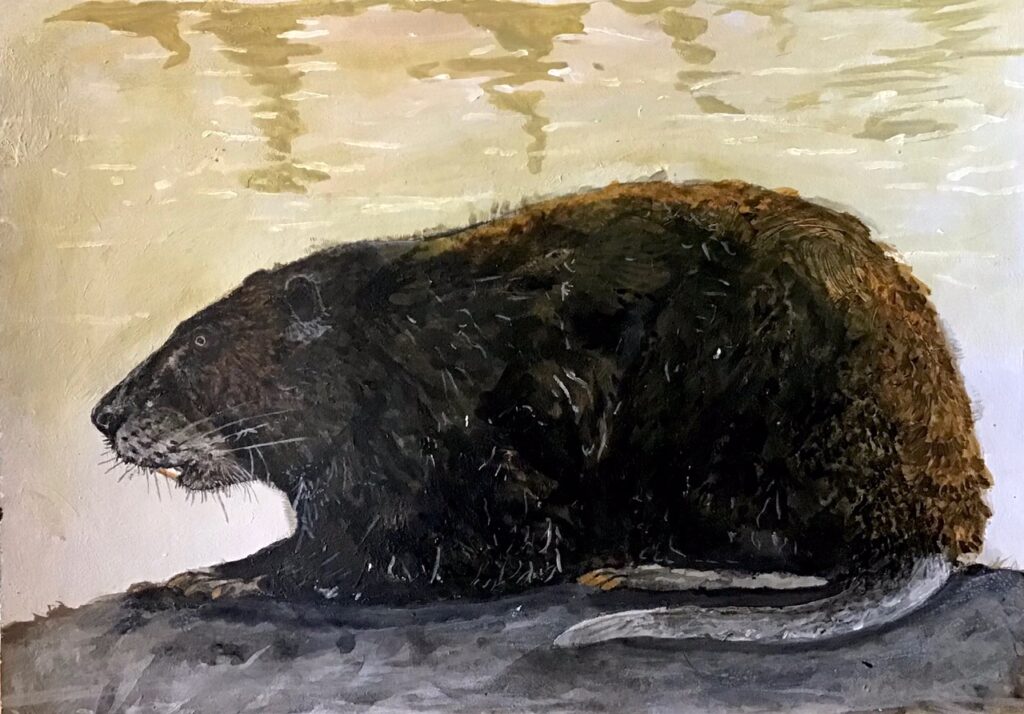
Trogontherium cuvieri by the sunset, Middle Pleistocene, Carpathian lowland – A terrestrially adapted beaver with agile limbs, no flattened tail and no webbed feet. Although spending much of the time on the ground, I believe it would be also seen around water bodies, perhaps also chilling (like on this recon), with that typical rodent-like chunky lying appearance. Done in acrylic.
References:
Fostowicz-Frelik Ł. 2008. — First record of Trogontherium cuvieri (Mammalia, Rodentia) from the middle Pleistocene of Poland and review of the species. Geodiversitas 30 (4) : 765-778.
Heinrich, W.-D., Maul, L. C. (2020): Mortality profiles of Castor and Trogontherium (Mammalia: Rodentia, Castoridae), with notes on the site formation of the Mid-Pleistocene hominin locality Bilzingsleben II (Thuringia, Central Germany). – Fossil Imprint, 76(1): 40–58, Praha. ISSN 2533-4050 (print), ISSN 2533-4069 (on-line).
Lopatin, Alexey. (2025). The Beaver Trogontherium cuvieri (Castoridae, Rodentia) from the Pleistocene of Central Yakutia. Doklady Earth Sciences. 522. 10.1134/S1028334X2560570X.
Vislobokova, I.. (1996). The Pliocene Podpusk-Lebyazh’e mammalian faunas and assemblage, Western Siberia. Palaeontographia Italica. 83. 1-23.
Yang, Yangheshan & Li, Qiang & Fostowicz-Frelik, Łucja & Ni, Xijun. (2019). Last record of Trogontherium cuvieri (Mammalia, Rodentia) from the late Pleistocene of China. Quaternary International. 513. 10.1016/j.quaint.2019.01.025.