Category Archives: Castorimorpha

Rhizospalax poirrieri: a fossorial castorimorph of Europe

Tooth-digging has convergently evolved multiple times among unrelated clades of fossorial rodents throughout the history of the Cenozoic. Contrary to the mole-like digging in which the forelimbs act as shovels, tooth and head digging forms possess unspecialized, relatively small feet, most of the digging is done by the one pair of incisors and the head. One clade of these animals is the Spalacinae.

Based on almost identical shape of the mandible, Rhizospalax was once thought to be a spalacid, but detailed examination of its skull and dentition showed that it was of the sciuromorphous, castoroid type. It possessed a large P4, which when present in muroids, is definitely smaller than M1 (spalacids are muroids). The dentition of Rhizospalax was therefore 1.0.1.2/1.0.1.2 (last premolar substituted the first molar – P4, M1, M2) unlike a typical muroid which has only three true molars. Moreover, its molar pattern is less complex as in muroidea, indicating a different ancestry. Another trait that links this taxon to castorids is the shape and position of the infraorbital canal.

Fossorial beavers are known from Oligocene of North America. As a french find, Rhizospalax is a proof that, tooth-digging castorimorphs likely once inhabited the whole holarctic realm, and occupied similar ecological niches now filled by the still-living Bathyergidae, arvicoline tribe Ellobuisini and Spalacidae.

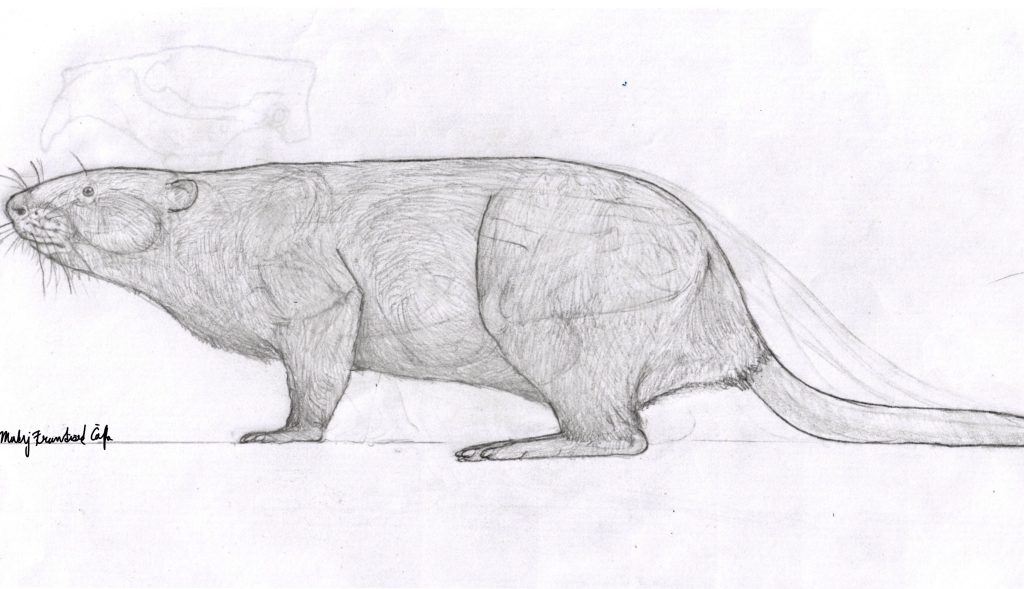
Here is shown my life reconstruction of Rhizospalax poirrieri. Missing components are based due to ecomorphological similarities, on Spalax, Tachyoryctes and Capacikala.

Literature:

  • A new rodent from the Upper Oligocene of France. Bulletin of the AMNH; v. 41, article 18. Gerrit Smith Miller, James Williams Gidley, B Poirrier, Claude Gaillard

Sinocastor anderssoni

The two extant species of beaver are listed in the genus Castor. Historically this genus had a very wide distribution, in Eurasia ranging from Iberian Peninsula to China and in America from Alaska to northern Mexico.

However, the specimens of Castor from Late Miocene of China exhibit a distinct morphology that falls out of its norms. Therefore, a new genus has been created to list these specimens, called Sinocastor. Some differences between these genera includes: more elongated rostrum and neurocranium with the latter being not as broad, narrow postorbital region, (which are considered to be a more primitive traits) relatively longer incisive foramina and more…

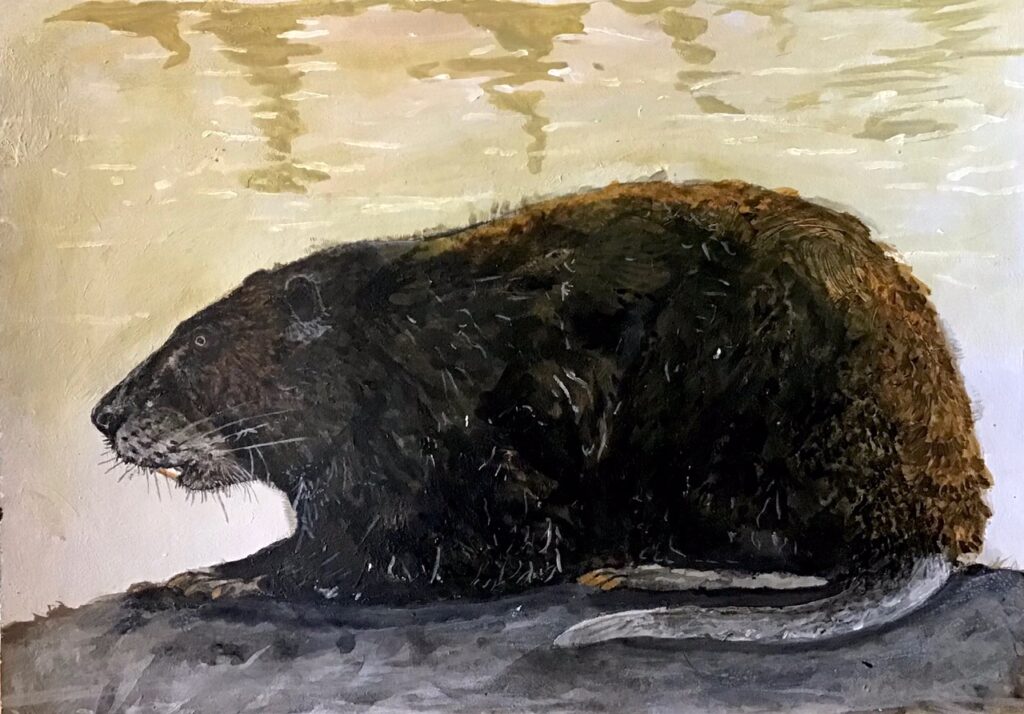
If Sinocastor is a sister to Castor, it would meant that, the common ancestor of these two genera (therefore of a still-living beavers) may come from East Asia. Castor may have dispersed northeastward via Beringian Isthmus to North America and northwestward to Europe.

Here I show my reconstruction of Sinocastor with missing parts filled in by Castor fiber:

Reference:

https://journals.plos.org/plosone/article?id=10.1371/journal.pone.0013990